California Rolls (with Tips on Cutting the Rolls). <Tips for cutting California rolls> To prevent the rolls from breaking apart, cut them with the plastic wrap on. Tilt the knife and slice slowly. <Tips for cutting California rolls> Moisten the knife with a wet towel before each slice so the cross section of the sushi roll will look neat. The filling is rolled wrapped with the nori (seaweed) sheet inside. So it is unique and kind of an inside out sushi roll. The California roll was created in the United States and reverse imported into Japan. 🍥 California rolls.
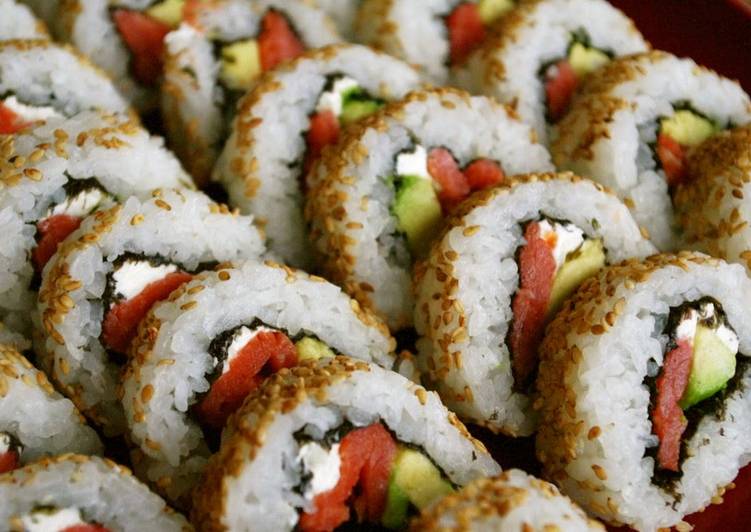 California rolls are larger then the maki sushi and use the whole sheet of nori.
The rice for this roll is presented on the outside and the seaweed is rolled into the inside.
The veg and fish are in the middle, just like in the maki sushi.
You can cook California Rolls (with Tips on Cutting the Rolls) using 8 ingredients and 16 steps. Here is how you achieve it.
California rolls are larger then the maki sushi and use the whole sheet of nori.
The rice for this roll is presented on the outside and the seaweed is rolled into the inside.
The veg and fish are in the middle, just like in the maki sushi.
You can cook California Rolls (with Tips on Cutting the Rolls) using 8 ingredients and 16 steps. Here is how you achieve it.
Ingredients of California Rolls (with Tips on Cutting the Rolls)
- Prepare 360 ml of White rice.
- You need 2 cm of square Kombu.
- Prepare 4 tbsp of Sushi vinegar.
- You need 4 of sheets Sushi seaweed.
- You need 100 grams of Smoked salmon.
- It's 1 of Avocado.
- It's 4 tbsp of Cream cheese.
- Prepare 1 of Sesame seeds.
California rolls are rolled inside out, which makes them very easy to fall apart when cutting. I hadn't been able to figure out how to cut them properly, but then I saw the sushi master at a popular local sushi restaurant cut them before removing the plastic wrap. I think using a very sharp knif. Serving California Rolls: Turn the cut California rolls on end and arrange on a serving platter or Sushi Plates.
California Rolls (with Tips on Cutting the Rolls) step by step
- <Making sushi rice> Cook 2 rice cooker cups of rice with water and konbu seaweed..
- Once the rice is cooked, transfer to a bowl or sushi oke (wooden bowl for sushi), and fold the sushi vinegar into the rice using a cutting motion..
- If you've used a bowl, transfer the mixed sushi rice to a flat plate and let cool. (This prevents moisture from collecting in the bottom of the bowl.).
- Meanwhile, cut the filling ingredients and put them on a plate..
- Cut the nori seaweed sheet into two-thirds. The rolls will be very thick if you use the whole sheet..
- On a sushi rolling mat, lay a nori seaweed sheet and spread out the sushi rice over the nori seaweed. Make sure all 4 corners are fully covered..
- Leave the sushi rolling mat, and transfer the nori seaweed and the sushi rice to a plate..
- Lay a piece of plastic wrap on the sushi rolling mat, and place the nori seaweed and sushi rice from earlier with the nori seaweed side up. Flip the plate slowly to position them neatly..
- Arrange the filling ingredients in the center of the seaweed. Put the avocado slices on the bottom side of the filling section. This way the salmon and cream cheese will keep the avocado from moving while rolling up..
- Roll it up using the sushi rolling mat. Be careful not to squeeze it too tightly..
- <Tips for rolling California rolls> When rolling up, bring the bottom end of the nori seaweed to the red dotted line shown in the picture so the sushi rice will act as a glue..
- Once the ingredients are rolled up, remove the plastic wrap and sprinkle the sesame seeds. Wrap the roll again with the plastic wrap and set aside for about 15 minutes..
- <Tips for cutting California rolls> To prevent the rolls from breaking apart, cut them with the plastic wrap on. Tilt the knife and slice slowly..
- <Tips for cutting California rolls> Moisten the knife with a wet towel before each slice so the cross section of the sushi roll will look neat..
- Once the rolls are cut, gently remove the plastic wrap..
- On a platter, carefully arrange the sushi rolls one by one, and it's done!.
A couple quick tips for rolling California Rolls or any type of maki. Make sure you do not overfill the roll. That was my biggest mistake when I made my first sushi roll. It seems like there is plenty of room, but in all reality, a few ingredients goes a long way. The goal is to seal the ends as tightly as possible, so none of the filling falls.