Seafood Ehomaki (Lucky Fat Sushi Rolls). Great recipe for Seafood Ehomaki (Lucky Fat Sushi Rolls). Since year after year, my family won't eat store-bought ehomaki, so I make them at home with seafood filling. By serving home-made ehomaki, I can save money, too. To reap the roll's rewards, though, setsubun celebrants must devour the whole bundle, one bite at a time, in total silence while facing a predetermined lucky direction, or ehō. Increase proportionately according to the number you want to make.
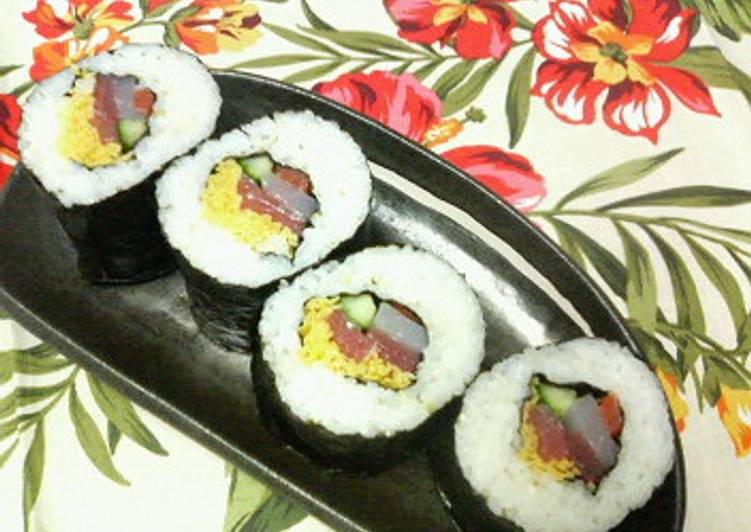 Basically, fortune rolls are just big fat sushi rolls eaten at this special time of year.
For those who are new to sushi rolls, they are a combination of special ingredients, put in rice, wrapped in seaweed.
Fortune rolls are usually fatter than standard rolled sushi.
You can cook Seafood Ehomaki (Lucky Fat Sushi Rolls) using 12 ingredients and 6 steps. Here is how you cook it.
Basically, fortune rolls are just big fat sushi rolls eaten at this special time of year.
For those who are new to sushi rolls, they are a combination of special ingredients, put in rice, wrapped in seaweed.
Fortune rolls are usually fatter than standard rolled sushi.
You can cook Seafood Ehomaki (Lucky Fat Sushi Rolls) using 12 ingredients and 6 steps. Here is how you cook it.
Ingredients of Seafood Ehomaki (Lucky Fat Sushi Rolls)
- You need 1 of Cooked white rice 4 to 5 rice cooker cups (1320 to 1650 grams cooked, using 720 ml to 900 ml uncooked raw rice).
- You need 10 cm of Kombu.
- You need 2 tbsp of Sake.
- You need 3 of to 5 tablespoons ○ Sugar.
- It's 1 tsp of ○ Salt.
- You need 1 dash of over 100 ml ○ Vinegar.
- It's 5 of to 7 sheets, nori seaweed.
- You need 200 grams of Sashimi grade tuna.
- It's 120 grams of Salmon (smoked or sashimi grade).
- It's 150 grams of Squid (sashimi grade).
- You need 5/8 of Cucumber.
- It's 50 grams of Shredded egg crepes (or Japanese atsuyaki thick omlette or dashimaki rolled omlette).
The sushi rolls usually contain seven ingredients, as seven is a lucky number. A special Japanese sushi roll that promises to bring luck and satisfy the taste buds, "Ehomaki" is usually enjoyed in early February as part of "Setsubun" festival, which marks the arrival of spring. It incorporates a mix of fresh and dried ingredients common in the Japanese pantry. The typical filling consists of a variety of vegetables, and sometimes with the addition of cooked fish like unagi (freshwater eel) or anago (saltwater eel).; It can be prepared ahead of time.
Seafood Ehomaki (Lucky Fat Sushi Rolls) instructions
- I use a handy fat sushi roll mold that I bought at a 100 yen shop, but you can also use a sushi mat. After rinsing the rice, I strain it and let it sit for 30 minutes. Then, I make small cuts on both sides of the konbu, add it to the rice together with sake, and then cook the rice. Next, I mix in the seasoned rice vinegar and cool off the rice with a hand-held fan. Finally, I put a damp cloth over the rice..
- The next step is to gather the filling ingredients. Shredded egg crepes, cucumbers, squid, salmon (either cheap smoked salmon or sashimi), and fresh, sashimi grade tuna. This will complete your color palatte of yellow, green, white, orange and red. Aside from the shredded egg crepe, all the ingredients should be cut lengthwise. For adults, use squid or salmon, together with a touch of wasabi..
- Wet the inner surface of the mold each time with water. Fill the mold with sushi rice, lay a 1/2 sheet of sushi nori in the center, arrange the fillers inside the nori, taking care to balance the colors, and seal the nori around fillers. Fill the rest of the mold with sushi rice and press the cover on..
- Drop the contents onto a sheet of sushi nori and roll to create an instant futomaki fat sushi roll! Even after making 5 rolls, a small bowl of sushi rice is left over. You can use that to make a mini Tekkadon (sushi rice topped with thin-sliced raw tuna sashimi) or Nattodon (sushi rice topped with fermented soy beans)..
- Cut them to serve. If you want to use less rice, just add more ingredients, if you please..
- Since my eldest son loves any kind of sashimi tuna, I fill these with plenty of tuna..
Usually, sushi rolls are sliced into bite-sized pieces. But fortune rolls aren't sliced since slicing indicates cutting good fortune. When eating fortune rolls, people face the good fortune direction of the year (eho) and make wishes. Carol Ann Rinzler, author of Nutrition for Dummies, points out that sushi is the very definition of a low-fat meal (as are fresh oysters and clams). Japanese people have a tradition of eating futomaki during Setsubun holiday.